arrow hitting digital target with precision, symbolizing enrollment accuracy success

Enrollment Errors Are Not Intake, They Are the Upstream System of Truth.

todayLast Updated: July 08, 2026

schedule10 min. read

Key Takeaways


  • Enrollment is the system of truth that downstream teams trust, even when it is wrong.
  • Most enrollment pain shows up later as denials, billing defects, and avoidable calls.
  • Fixing post activation errors costs more because every downstream workflow has already acted on the defect.
  • Focus on prevention: validation, matching, exception workflows, and feedback loops.
  • Treat defects as recurring incidents, not one off tickets, and fund upstream controls accordingly.

Enrollment errors are not an enrollment problem

Health plans often treat enrollment like intake. An 834 file arrives, a portal submission posts, a broker feed lands, and the job is to load the record and move on. When something is wrong, the fix is to correct the record, close the ticket, and keep the queue moving.

That framing is comfortable - and expensive. Enrollment data is not just a starting point. It is the upstream system of truth that every downstream process relies on. When the upstream truth is wrong, downstream teams do not fix it right away. They discover it, usually in the worst possible moment, during a claim, a bill, a provider eligibility check, or a member call.

Scaling enrollment is often treated as an intake capacity issue, and the goal becomes speed to load.

At enGen, we see a different reality: first time accuracy is what determines speed later, because defects turn into repeat work across teams.

What this means in practice is that enrollment is a cross functional reliability problem, and it deserves the same rigor you apply to claims controls and financial reconciliation.

Every error is a delayed operational incident. Claims and service teams just discover it later.

How upstream defects become downstream pain

Enrollment and eligibility operations sit at the intersection of many sources. For many plans, this includes 834 transactions, employer eligibility files, state enrollment systems, broker feeds, and member submitted updates through portals. Each source has its own timing, formatting, and logic. The plan is left to reconcile conflicts and decide what is true.

When reconciliation fails, the defect does not stay in enrollment. It propagates. Claims adjudication trusts the eligibility span. Billing trusts the premium and plan mapping. Provider eligibility checks trust coverage and network configuration. Member service trusts the member record when answering the phone.

If you want fewer denials and fewer avoidable calls, the most durable leverage is upstream prevention, not downstream rework.

The cascade in plain terms

  • Effective date defects create retroactive eligibility changes, reversals, and reprocessing.
  • Dependent relationship defects create mismatched coverage, incorrect cost share, and confusion at the point of care.
  • Plan mapping defects create incorrect benefits, incorrect premium billing, and identification card issues.
  • COB defects change which payer is primary and can trigger denials, refunds, and rework.

Why downstream clean up keeps winning the budget

Downstream work is visible. Denials show up in reports. Members call and complain. Providers escalate when eligibility is incorrect. Those signals create urgency, and urgency attracts funding.

Upstream prevention is quieter. The avoided call never happens. The prevented denial never appears. The reconciliation that did not need to occur never gets counted. Because the benefits are distributed, no single team gets full credit, and the business case can feel abstract even when the operational pain is constant.

A practical reframe: treat enrollment defects like recurring incidents

If a claim system produced the same denial pattern every week, most plans would not treat each denial as a ticket. They would investigate root cause, change the control, and monitor whether the issue recurs. Enrollment deserves the same discipline.

The shift is simple to describe and hard to execute. Instead of asking, "How fast can we close this enrollment ticket", ask, "Why did this defect get created, and what control would prevent it from being created again".

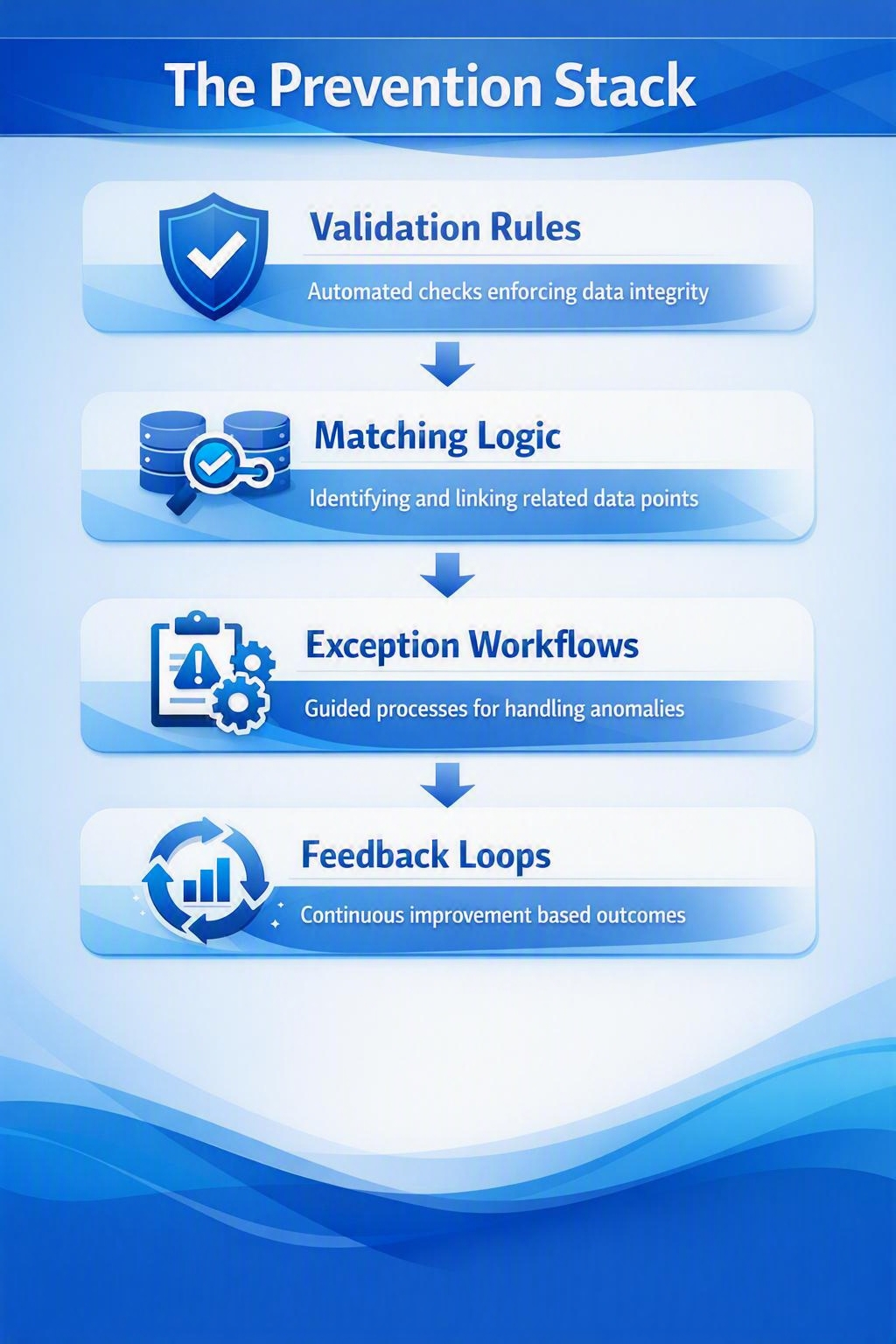
infographic summarizing the four key controls of the prevention stack

The Prevention Stack: four controls that reduce error creation

Across high volume enrollment and eligibility operations, prevention programs tend to rely on a small set of control types. You can think of them as a stack. Each layer catches a different class of defect.

1) Validation rules that reflect business reality

Validation rules are checks that confirm incoming data meets defined expectations before it becomes the record of truth. The point is not to reject everything. The point is to catch predictable defects early, when the fix is cheap and the downstream impact has not happened.

Examples include date logic, coverage span overlap checks, dependent relationship constraints, and plan code to benefit mapping checks. The best rule sets are owned jointly by operations and technology, and they evolve as sources change.

2) Matching logic that prevents duplicate or split identities

Member matching is the logic used to determine whether an incoming record belongs to an existing member or represents a new identity. Poor matching creates duplicates, splits coverage spans, and triggers conflicting truth across systems.

Matching works best when it uses multiple identifiers, applies deterministic and probabilistic methods where appropriate, and includes clear exception handling for ambiguous cases. Probabilistic matching means using weighted signals, like name, date of birth, and address, to estimate whether records refer to the same person. It should be explainable and auditable, not a black box.

Organizations often assume matching is a one time technology decision, set it and forget it.

In our experience working with payer operations, matching behaves more like an operational control that needs stewardship, because source data quality and member demographics change over time.

What this means in practice is that the best programs treat matching thresholds and exception categories as living policy, with review cycles and feedback from downstream error patterns.

3) Exception workflows that make the right work easy

Even strong validation and matching will produce exceptions. The question is whether exceptions become friction or a controlled process. Exception workflows define how cases are routed, who decides, what evidence is required, and how decisions are recorded.

Design matters. If analysts cannot see source history, compare conflicting inputs, and document a decision quickly, the workflow will drift into workarounds. Workarounds create new defects, and the cycle continues.

4) Feedback loops that turn downstream signals into upstream fixes

A feedback loop is the mechanism that turns downstream discovery into upstream prevention. It connects claim denial patterns, billing adjustments, provider escalations, and contact center drivers back to enrollment defect categories and root causes.

The loop is not just a meeting. It needs a taxonomy, ownership, and a path to change rules, data mappings, or upstream source behavior. Without that, the same defect types will recur, and the plan will keep paying for the same lesson.

If you only fix records, you will keep funding clean up. If you fix the control, you start buying down the entire defect curve.


A simple table: defect types and the downstream blast radius

Common defect type

Where it shows up later

Why it is costly

Effective date or coverage span errors

Claim denials, reprocessing, retro eligibility changes

Triggers reconciliation, provider abrasion, and member confusion

Dependent relationship or demographic mismatches

Incorrect cost share, eligibility check failures, service calls

Creates repeat touches and erodes trust at the point of care

Plan mapping or benefit configuration issues

Billing errors, ID card issues, benefit misalignment

Creates financial adjustments and member dissatisfaction

COB errors

Denials, refunds, improper payment recovery

Requires investigation across payers and manual coordination

What this looks like in practice: the enrollment reliability loop

If you want a workable operating model, start small and make it measurable without inventing metrics. The goal is to create visibility into recurrence and to shorten the time from detection to prevention.

Step by step checklist

  1. Define a defect taxonomy that enrollment, claims, billing, and member service can all use.
  2. Tag exceptions and downstream issues to that taxonomy, even if the tagging is initially manual.
  3. Identify the top recurring defect categories by volume or pain, not by anecdote.
  4. For each category, document the upstream sources, the control gaps, and the decision points.
  5. Implement or refine validation, matching, or workflow controls for the category.
  6. Create a simple monitoring cadence to confirm whether recurrence decreases.
  7. Feed lessons back to upstream sources and data governance owners so the fix sticks.

First time accuracy is not a slogan. It is the cheapest form of administrative simplification.

Where prevention fails, and how to make it stick

Prevention programs often stall for predictable reasons. One is split ownership. Enrollment owns intake, claims owns denials, the contact center owns calls, and no one owns the end to end defect story.

Another is tooling without workflow. Rules exist, but exceptions are hard to work. Or workflows exist, but they are not connected to downstream signals. A third is slow governance. By the time a rule change is approved, the source has already changed again.

Large scale enrollment operations are often treated as a data problem, and the assumption is that better data alone will solve it.

At enGen, this typically shows up as a workflow problem too: the decision points are unclear, exceptions are handled differently by different teams, and the same defect gets reintroduced.

What this means in practice is that prevention requires operational design and governance, not just technology changes, because controls only work when people can use them consistently.

A leadership lens: fund the control, not the cleanup

For operations leaders, the most important move is budget alignment. Downstream cleanup is necessary. It is also the most expensive way to learn. When you invest only in cleanup, you institutionalize defects as normal cost of doing business.

Funding upstream prevention does not mean building a perfect front door. It means targeting the defect categories that create the most downstream pain and designing controls that stop recurrence. It also means sharing the benefit. Claims, billing, provider relations, and member service all win when enrollment truth is stable.

The fastest way to improve member experience through back office excellence is to stop creating avoidable defects in the first place.

Downstream teams are not your safety net. They are your early warning system.

Enrollment is where operational resilience starts

Operational resilience is the ability to absorb change without creating chaos. Enrollment and eligibility are exposed to constant change, new products, new state requirements, new employer rules, new broker behaviors, and new member expectations. If your upstream truth is brittle, every change becomes a downstream incident.

The industry tension is real: you need speed, but you can’t afford error.

At enGen, we often see that speed and accuracy stop being tradeoffs when teams treat enrollment like a reliability system, with clear controls and feedback loops.

The goal isn’t a heroic cleanup team, it’s a system where the right outcome is the default.

If you’re working through recurring enrollment and eligibility defects and want a sounding board on upstream prevention strategies, contact enGen. We are happy to compare notes and share what tends to work in real operations.

FAQs

An 834 is a standard electronic transaction used to send enrollment and benefit information between organizations, such as employers, brokers, and health plans.

Eligibility is the determination that a member has active coverage for a given period and benefit plan, which downstream systems use to adjudicate claims and answer coverage questions.

Claims systems rely on coverage spans, plan mapping, and member identity. If those inputs are wrong, the claim can deny even when the member should be covered.

Coordination of benefits (COB) is the process used when a member has more than one coverage source, to determine which payer is primary and how costs are shared.

Start with a defect taxonomy and a feedback loop, then implement targeted validation and workflow controls for the top recurring defect categories.

Enrollment and eligibility, claims operations, billing, the contact center, data governance, and technology partners all play roles because the defect cascade crosses functions.

Track recurrence of top defect categories, exception aging, and downstream issue drivers tied to enrollment defects. Use existing operational reporting where possible.