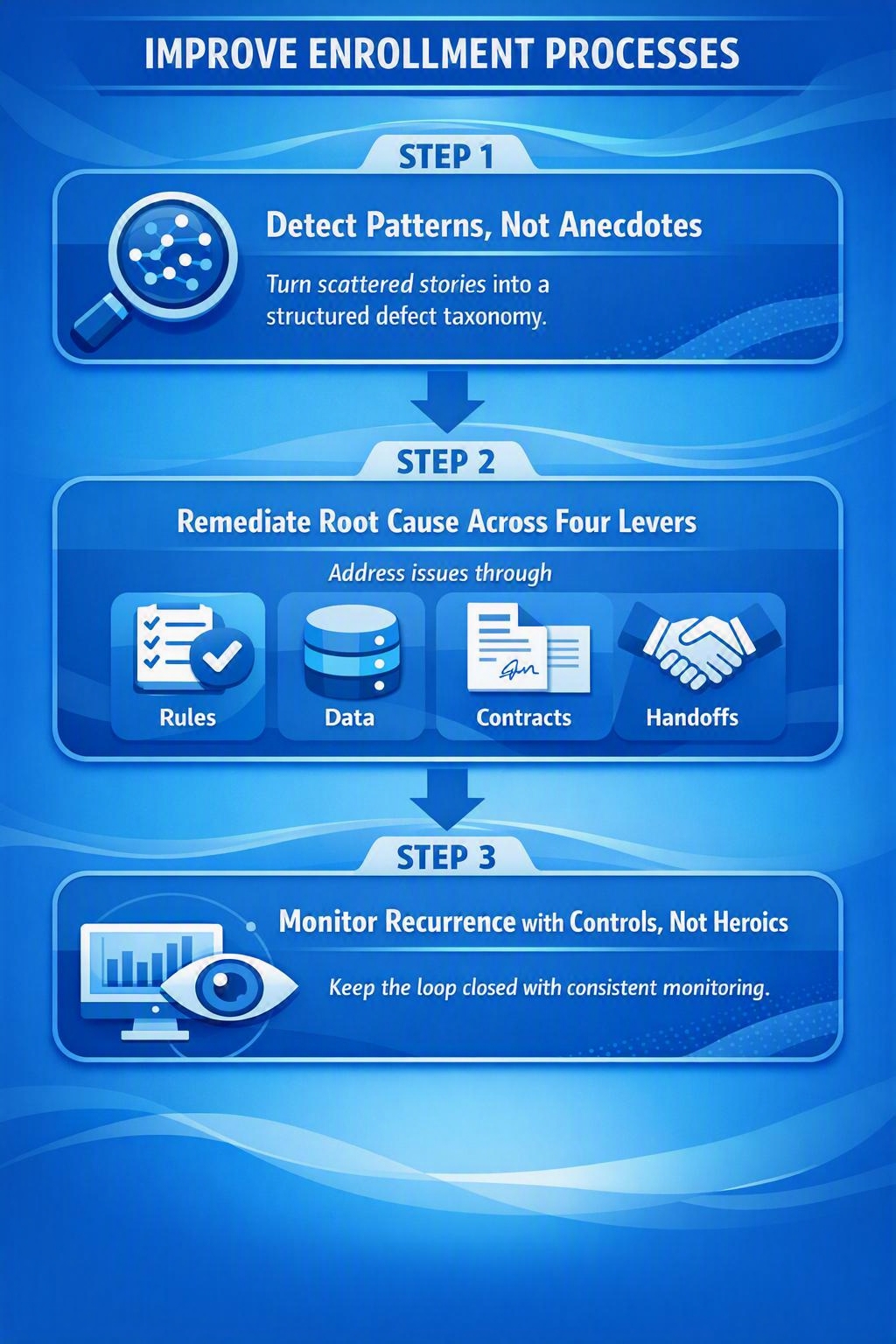
Step 1: Detect patterns, not anecdotes
Most organizations start with stories: a high-profile claim, a surge in calls, a noisy employer group. Stories matter, but they are not a measurement system. Pattern detection means turning scattered exceptions into a structured defect taxonomy.
A simple starting taxonomy:
- Eligibility dates and retroactivity defects
- Plan or product misalignment defects
- Group or employer feed mismatches
- Dependent relationship and coordination of benefits defects
- Duplicate coverage or termination defects
- Benefit configuration and rule interpretation defects
Then connect each defect type to at least one downstream symptom: pended claims reason codes, call drivers, billing adjustments, or reconciliation issues. The goal is to see recurrence and impact together.
Defect tracking is often treated as a reporting exercise that lives outside the work.
In our experience working with payer operations, the loop starts working only when the taxonomy is embedded into the queues people already use and when every correction captures a structured reason code.
What this means in practice is that the best data often comes from the front line, but only if you make it easier to classify a defect than to type a free-form note.
Step 2: Remediate root cause across four levers
Root cause sounds like a single answer, but enrollment defects usually live at intersections. A helpful way to structure remediation is to look across four levers: rules, data, contracts, and handoffs.
- Rules: eligibility and benefit rules that are ambiguous, conflicting, or inconsistently applied across systems.
- Data: mappings, transformations, and field-level definitions that introduce drift or incomplete records.
- Contracts: how plan documents, group setups, and benefit interpretations translate into configuration and enrollment handling.
- Handoffs: timing, ownership, and workflow boundaries across enrollment, billing, service, and claims.
A root-cause fix is complete only when the error-creation mechanism is changed. If retroactive eligibility updates arrive late, the fix might involve feed timing, reconciliation logic, and a rule for how downstream processes handle the update window. If dependent relationships are frequently wrong, the fix might involve employer data validation, front-end controls, and clearer exception ownership.
Step 3: Monitor recurrence with controls, not heroics
Even strong fixes drift without monitoring. New groups come on. Benefits change. Vendors shift formats. People turn over. Monitoring is how you keep the loop closed.
Practical monitoring moves:
- Set weekly defect review for the top defect types, with clear owners for investigation and remediation.
- Define control limits for defect volumes and cycle time, so spikes trigger action early.
- Create a small set of leading indicators, such as feed timeliness, reconciliation exceptions, or duplicate coverage flags.
- Build audit checks into upstream workflows, including pre-load validation and post-load reconciliation.
- Document fixes as reusable standards, not tribal knowledge.


Share